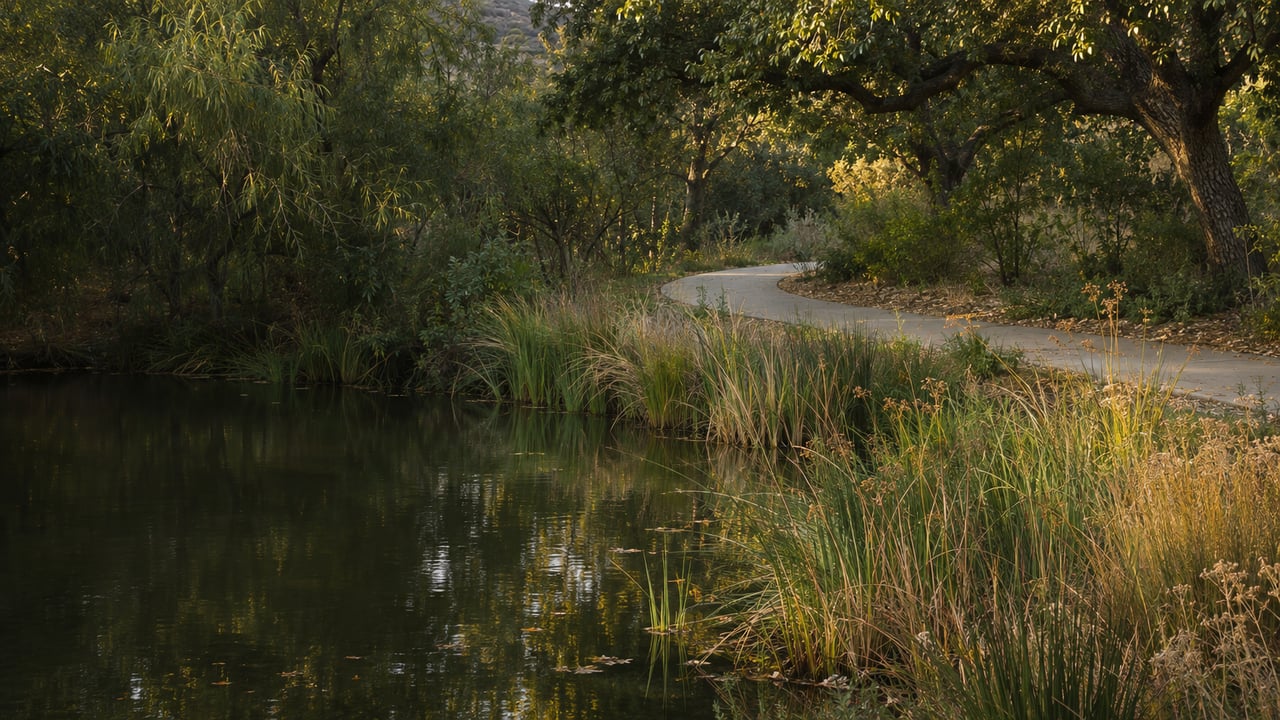
"Most importantly it will be the park that establishes the standards that all parks going forward will adhere to," Joseph T. Edmiston, executive director of the Santa Monica Mountains Conservancy, said at the August 2024 groundbreaking, according to a Councilmember Bob Blumenfield press release. He was talking about about an acre and a half of former vacant land on Lindley Avenue, just south of Victory Boulevard, where Caballero Creek runs into the Los Angeles River.
The Mountains Recreation and Conservation Authority scheduled a "Celebration of Completion of Caballero Creek Wetlands Park" for 8:30 a.m. on November 9. A separate event listing showed the ceremony as free. The city calls it the first self-sustaining park in Los Angeles. The boardwalk and benches are the parts you see, but the park is really a small water treatment system. That design explains why it took so long, who will run it, and which nearby project matters most for people who live close by.
What "Self-Sustaining" Means at 6353 Lindley Avenue
The Blumenfield release explains the term simply. Water is captured on and off the site, solar power cleans it, and the clean water irrigates the park. The city's LA Stormwater blog goes a step further and calls it LA's first "net-zero, self-sustaining park." It says the system will treat both stormwater and dry-weather runoff on site.
The California Coastal Conservancy's 2017 staff recommendation laid out how the water was designed to move through the site:
- Runoff from Lindley Avenue enters a catch basin, passes through filters, and flows into a bioswale, where it soaks into the ground.
- Pumps draw water from Caballero Creek and push it through filters into a constructed wetland.
- From the wetland, the water moves to the bioswale.
- Whatever is left goes into a cistern and is used to irrigate the park.
An MRCA staff report from July 2017 adds the hardware: intake and return points on the creek, sediment and debris screens, a cistern, photovoltaic panels, and a return line that sends extra treated water back into Caballero Creek. The Conservancy document puts the solar panels on the roof of the shade structure, where they power the filtering, pumping and irrigation. At the design stage, the wetland was expected to treat about 8.5 acre-feet of water a year.
So the shaded platform you sit under also powers the pumps, and the plants along the path are watered by runoff that came off the street outside.
Why the City Wanted a Water System Here
The LA Stormwater blog also explains why the city cares. Treating water at Caballero Creek helps LA Sanitation meet its limits on trash, bacteria and metals in the LA River under its municipal stormwater permit. In the blog's words, "treating stormwater at Caballero Creek helps decrease the amount of pollutants in the LA River."
The location fits that job. MRCA describes Caballero Creek as the only tributary of the LA River that starts in the Santa Monica Mountains. A wetland at the point where the creek meets the river catches that water before it joins the main channel.
The plan also has a teaching side. Blumenfield partnered with Reseda High School so students can use the space as an outdoor classroom. Leonard Shaffer, then president of the Tarzana Neighborhood Council, said at the groundbreaking that a key goal was "to have a place where residents of Tarzana, students from Reseda High School, and residents of surrounding communities can learn about water reclamation and conservation."
What Was Built Around the Plumbing
The project scope the city filed in 2024 lists the visitor features:
- A walking path with a boardwalk beside the wetlands
- Outdoor fitness equipment
- A shade trellis that doubles as an outdoor learning area
- Native plants and trees, wetlands and bioswales
- Educational signs, benches and other seating
- A hydration station and a bicycle rack
- Fencing and gates
Most of these sit right next to the water system. The boardwalk exists because the wetland does, the signs explain the treatment process, and the trellis carries the solar panels. The fitness equipment is the main feature with no link to the water.
Twelve Years From First Drawing to Completion
A treatment system with pumps, filters and solar controls is harder to build than a lawn with a playground, and the timeline reflects that. The original design work goes back to a 2014 proposal from BlueGreen Consulting, with Lynne Dwyer as lead designer. MRCA later expanded BlueGreen's design contract.
| Date | Milestone | Projected opening at the time |
|---|---|---|
| September 2014 | BlueGreen Consulting design proposal | Not stated |
| June 2017 | Coastal Conservancy staff recommendation, about $2.95 million financing plan | Not stated |
| August 1, 2024 | Ceremonial groundbreaking, about $5.5 million budget | Around April 2025 |
| August 2024 | Urbanize LA construction report | Summer 2025 |
| May 2025 | Streetsblog LA reports construction underway | That summer |
| June 2026 | LA Stormwater reports construction wrapping up | Official opening update promised |
| November 9, 2026 | MRCA Celebration of Completion scheduled |
The budget nearly doubled along the way. The 2017 plan totaled $2,946,500 and drew on Coastal Conservancy Proposition 1 money, a state urban greening grant, city and county funds, and Santa Monica Mountains Conservancy Proposition 84 money. By the 2024 groundbreaking, Urbanize LA reported a $5.45 million project. The state covered $4.4 million, the City of Los Angeles $750,000, and Los Angeles County $300,000. Blumenfield's office said the project combined seven separate funding sources.
Who Runs a Park That Is Also a Treatment Plant
Most neighborhood parks are run by one department. Here, the LA Stormwater blog reported in June 2026 that MRCA "will soon be handing over the operation reins" to two city agencies: the Safe Clean Water Implementation Division and LA Recreation and Parks.
The split follows the design. A water-quality division runs the system that has to keep pollutants out of the river, and the parks department runs the benches, fitness stations and gates. For neighbors, that means two places to check for updates. The LA Stormwater blog has promised to post when the park officially opens to the public. MRCA's project page also tracks the site.
The timing is useful. The city's rainy season runs from October 15 to April 15, according to a Tarzana Neighborhood Council bulletin posted in October. The park's first winter is the first real test of how much water its system catches.
The River Path Is the Bigger Change
The groundbreaking release said the site plan includes access to the LA River bike paths. Since 2017, planners have described an LA River Greenway segment running next to the park. Today, the City's river page describes the existing West Valley Bikeway as running from Mason Avenue to Vanalden Avenue.
The next piece now has a contract. Streetsblog LA reported that on September 28, 2026, the Board of Public Works approved an $84 million construction contract for the Los Angeles Riverway West San Fernando Valley project. The project will run 2.9 miles from Vanalden Avenue to Balboa Boulevard and is meant to open before the 2028 Olympics. Streetsblog also reported that the scope was scaled back. It now includes five street-level crossings, where riders press a button to cross traffic, and one undercrossing.
The park was planned as a stop on a continuous river route, which is why its scope includes a bike rack and a hydration station. It also follows a pattern the West Valley has seen before. Blumenfield's office counts it alongside the LA River and Aliso Creek Confluence Park at Wilbur Avenue and Kittridge Street in Reseda, which opened in 2016, and Costanso Fire Station 84 Park in Woodland Hills, created in 2015. The Caballero Creek park adds a working water system to that list.
For more on what's happening along Tarzana's main corridors, see our Tarzana neighborhood guide or our look at the Ventura Boulevard garden that became the Tarzana Community & Cultural Center. Studio City's riverfront is going through its own set of plans, covered in our river path piece.
Caballero Creek shows how long a public project with pumps, permits and seven funding sources can take to reach its completion celebration. Projects like this are part of how Tina Damadyan reads a block: what's being built nearby, who will maintain it, and when it will actually be finished. If you're curious how projects like the Riverway or the new park could affect your street, schedule a free consultation and we can go through the timelines together.